
Pennsylvania Sex Offender Registry
Pennsylvania's Megan's Law registry is a publicly accessible database of convicted sex offenders living, working, or attending school in the state. The Pennsylvania State Police manages this registry and makes it available to the public through meganslaw.psp.pa.gov. Anyone can search without creating an account or paying a fee. The registry spans all 67 counties and is updated regularly as offenders report changes to their addresses, employment, and other required information.
Pennsylvania's sex offender registration law is codified in 42 Pa.C.S. Chapter 97. Key provisions include Section 9799.28, which governs public access to registry data, and Section 9799.63, which addresses specific registry obligations. The law separates offenders into tiers based on offense severity, with each tier carrying different registration periods and reporting schedules. Residents across Pennsylvania can use the registry to check nearby addresses, look up specific individuals by name, or monitor changes through the electronic notification system.
Pennsylvania Sex Offender Registry Quick Facts
Pennsylvania Sex Offender Registry and Megan's Law
Pennsylvania's Megan's Law has gone through several revisions over the years. The most significant changes came with the Sexual Offender Registration and Notification Act (SORNA), which took effect for offenses committed on or after December 20, 2012. SORNA introduced a tiered classification system, stricter reporting intervals, and expanded notification procedures for the most dangerous offenders. Prior to SORNA, Pennsylvania operated a two-category system with ten-year registrants and lifetime registrants, both reporting annually.
The Pennsylvania State Police bears primary responsibility for maintaining the statewide sex offender registry. The agency verifies offender-reported information, updates registry records, and ensures compliance with reporting requirements. The State Police also work with local law enforcement agencies across the state to monitor registered sex offenders and investigate registration violations. Their role is defined in 42 Pa.C.S. § 9799.32, which lays out the State Police's obligations under Megan's Law.
The official disclaimer from the Pennsylvania State Police notes that some information on the registry may be outdated or inaccurate, and the site is not a comprehensive listing of every person who has ever committed a sexual offense in Pennsylvania. The registry reflects only those offenders currently required to register under the law.
The State Police site also includes this warning: any person who uses the information on the registry to threaten, intimidate, or harass a registrant or their family, or who misuses this information in any other way, may face criminal prosecution or civil liability. The registry exists to protect communities, not to enable harassment.
The Pennsylvania State Police's main Megan's Law homepage serves as the central hub for offender searches and registry information. The screenshot below shows the main Megan's Law homepage as it appears to the public.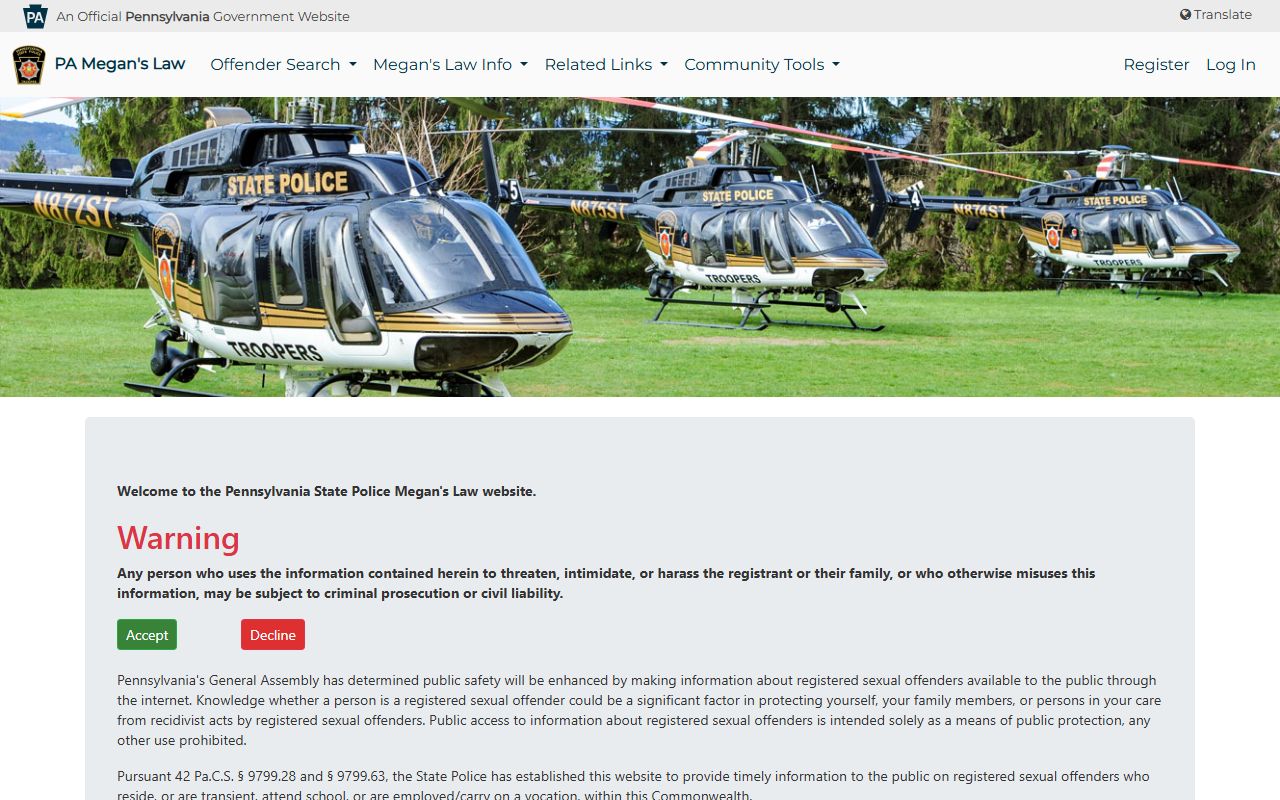 This portal gives Pennsylvania residents direct access to the full registry database along with search tools, educational resources, and notification signup options.
How to Search Pennsylvania Sex Offenders
The Pennsylvania Megan's Law website offers several ways to search for registered sex offenders. You can search by offender name if you know who you are looking for. You can also search by location using a county, municipality, zip code, or a radius around a specific street address. The address radius tool is especially useful for homeowners and parents who want to know about registered offenders living close to their home or their child's school.
Each offender profile in the Pennsylvania registry includes name and known aliases, year of birth, current residence address, employment address, school address if applicable, a photograph updated at least annually, a description of the offense, and the conviction date. This level of detail gives residents enough information to recognize an offender and understand the nature of their offense. The FAQ page on the Megan's Law site answers common questions about how the database works and what information is available to the public.
The FAQ section of the Megan's Law website addresses many of the most common questions about searching the registry. This screenshot shows the official FAQ page for the Pennsylvania sex offender database.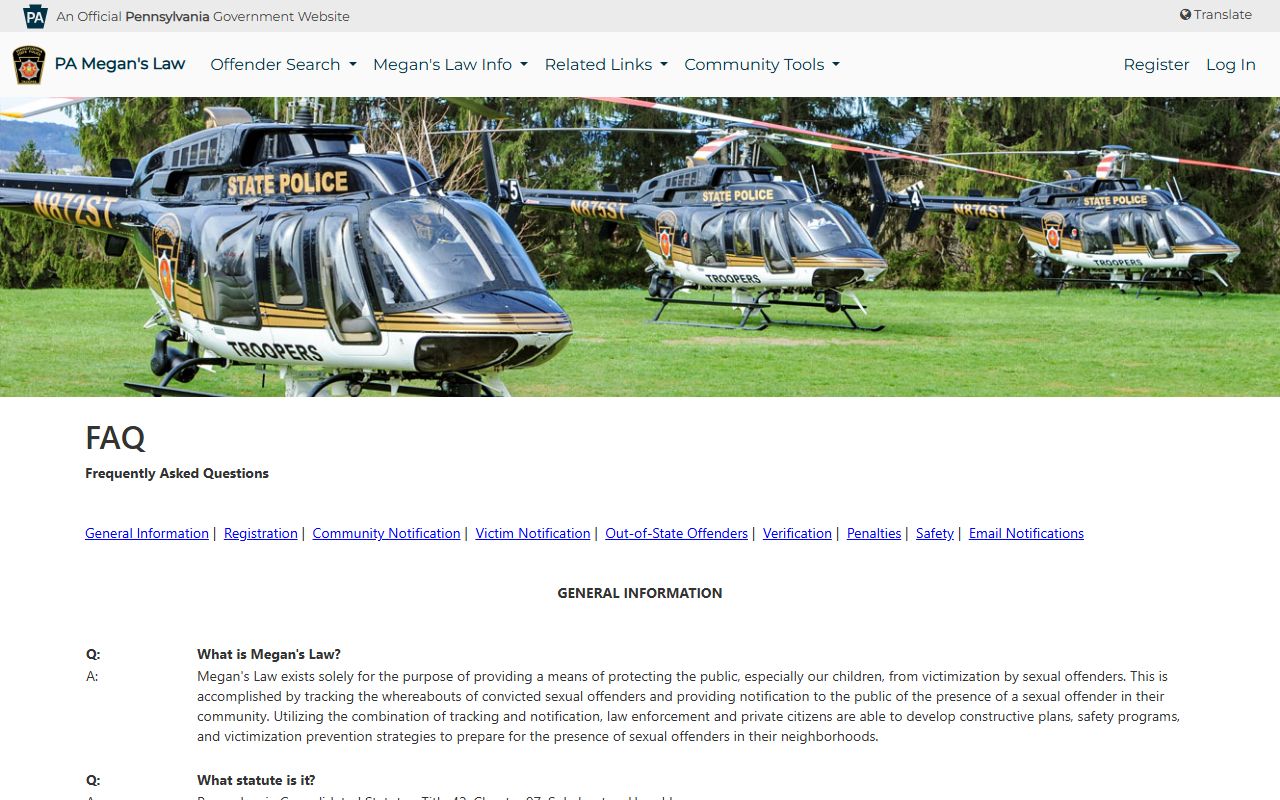 The FAQ page clarifies what information is public, how to interpret search results, and what to do if you believe registry information is incorrect.
Note: The sex offender registry search is free to use and does not require creating an account on the Pennsylvania Megan's Law website.
Pennsylvania Sex Offender Classification Tiers
For offenses committed on or after December 20, 2012, Pennsylvania classifies registered sex offenders into three tiers. Tier placement depends on the specific offense of conviction. More serious offenses result in longer registration periods and more frequent reporting obligations. The tier system replaced the older two-category system and brought Pennsylvania into alignment with federal SORNA standards.
Tier I offenders register for 15 years and must report to verify their information once per year. Tier II offenders register for 25 years and must report every six months. Tier III offenders face lifetime registration and must report quarterly. Sexually Violent Predators (SVPs) also register for life and report quarterly, but they carry additional community notification obligations that standard Tier III offenders do not have. Sexually Violent Delinquent Children (SVDCs) are also subject to lifetime registration.
Transient offenders, meaning those without a fixed address, must report monthly. Offenders who registered under the old pre-SORNA system and fell into the ten-year category remain on an annual reporting schedule. Those who were lifetime registrants under the old system also report annually, though their registration remains permanent. The differences between old-law and new-law registrants matter for how and when they must report, even if some registration periods are similar on the surface.
The registration details page of the Megan's Law website explains exactly when and how offenders must report their information. The screenshot below shows the registration details page in full.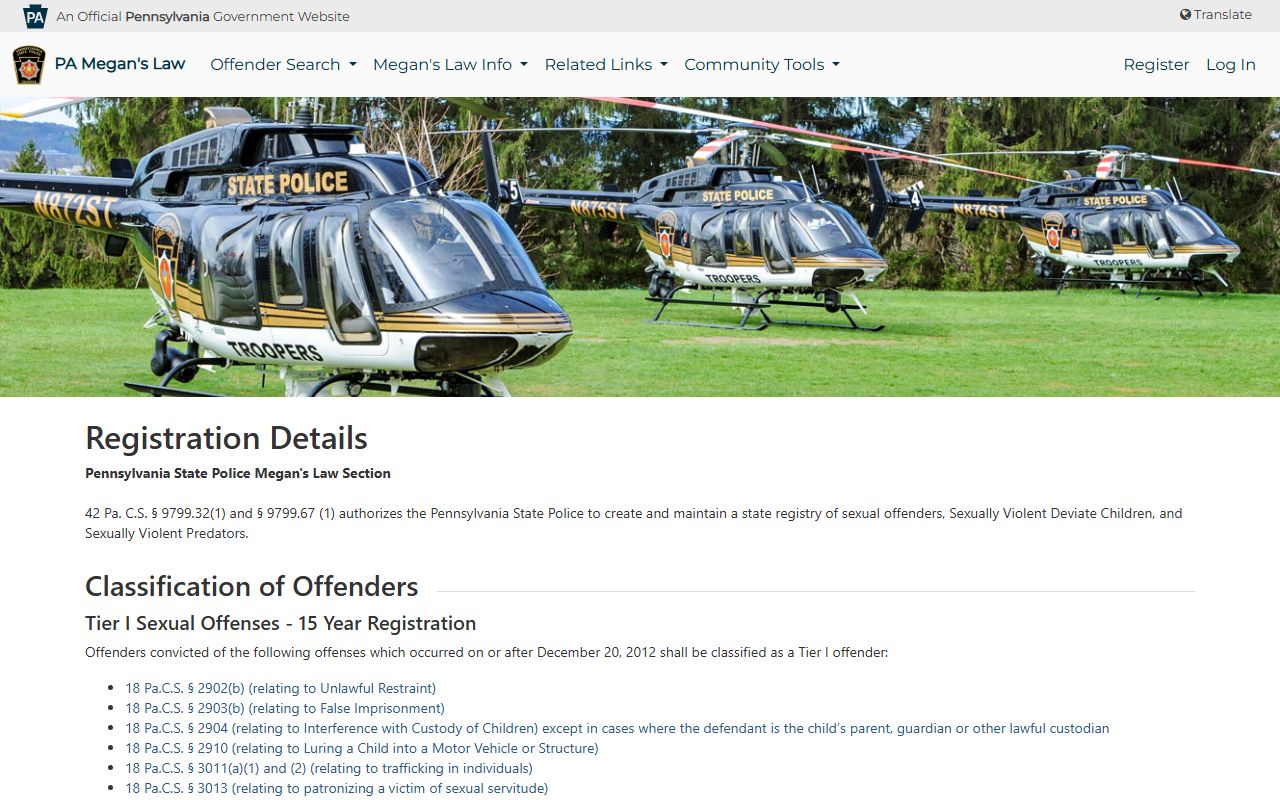 This page covers the mechanics of the registration process, including where offenders report, what information they must provide, and what happens if they fail to comply.
Note: Tier placement is determined by the offense of conviction, not by a court's individual assessment of an offender's current danger level in Pennsylvania.
Registration Requirements in Pennsylvania
Pennsylvania sex offenders must report any change to their registration information within three business days of that change occurring. This applies to changes in residence, employment, school enrollment, phone number, vehicle information, temporary lodging, email addresses, and internet identifiers. The three-day window is strict. Failing to report a change on time is a criminal offense under Pennsylvania law.
Offenders who plan to travel internationally must appear in person at a registration site at least 21 days before their planned departure. This requirement allows law enforcement to notify foreign authorities and track offenders who leave the country. The requirement applies regardless of the destination country or the length of travel planned. Domestic travel within the United States does not trigger the same advance notice requirement, though offenders who establish temporary lodging for more than a brief period must still report that address.
The relevant statutes governing registration requirements are 42 Pa.C.S. § 9799.55 (registration requirements), § 9799.56 (registration procedures), and § 9799.60 (verification of residence). Section 9799.13 governs which offenders the law applies to, while § 9799.15 sets the registration periods for each category of offender. These statutes are available in full through Title 42, Chapter 97 of the Pennsylvania Consolidated Statutes.
The Pennsylvania Code and Bulletin contains the administrative guidelines that govern how Megan's Law is administered across the state. This image shows the Megan's Law administration guidelines at Section 56.3.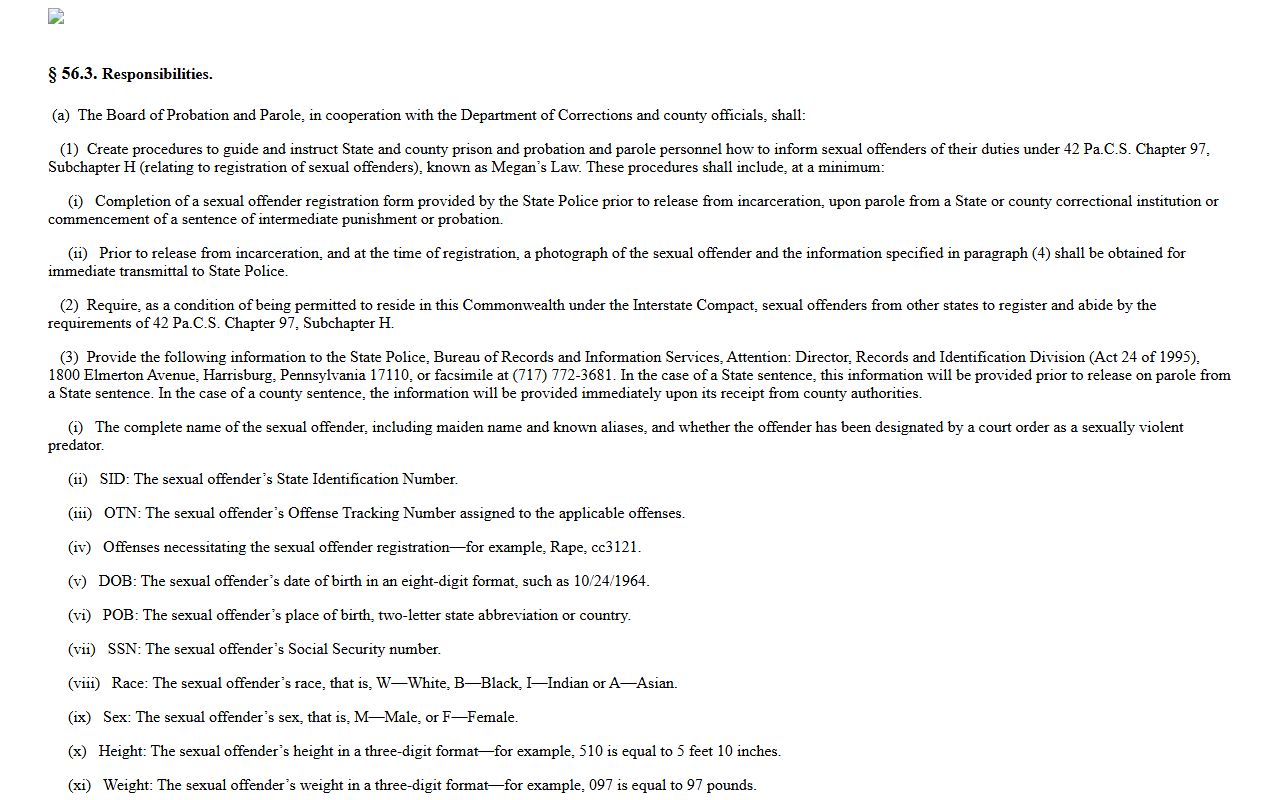 These guidelines provide detailed procedural rules for how registration is carried out by the State Police and other agencies involved in the process.
Pennsylvania Sex Offender Crimes and Offenses
Pennsylvania's Megan's Law applies to people convicted of a defined list of offenses under the Pennsylvania Crimes Code. Section 9799.14 of Title 42 specifies which offenses require registration and at which tier. The list covers a broad range of sexual offenses, from crimes involving physical contact to those involving the exploitation of children through electronic means.
Among the offenses requiring registration are Rape (18 Pa.C.S. § 3121), Statutory Sexual Assault (§ 3122.1), Involuntary Deviate Sexual Intercourse (§ 3123), Sexual Assault (§ 3124.1), Institutional Sexual Assault (§ 3124.2), Aggravated Indecent Assault (§ 3125), and Indecent Assault (§ 3126). Crimes involving children include Sexual Abuse of Children (§ 6312), Unlawful Contact with a Minor (§ 6318), and Sexual Exploitation of Children (§ 6320). Trafficking in Individuals (§ 3011) and Invasion of Privacy (§ 7507.1) also appear on the list of registrable offenses in Pennsylvania.
Out-of-state and federal convictions may also trigger registration in Pennsylvania. When a person moves to Pennsylvania or is released from a Pennsylvania facility after a conviction in another jurisdiction, the State Police assess whether the offense is substantially equivalent to a Pennsylvania registrable offense. If it is, the person must register in Pennsylvania for the period that corresponds to their tier classification. The Crimes Code page on the Megan's Law site lists the specific offenses covered under each tier.
The Crimes Code section of the Megan's Law website allows the public to review which specific offenses require registration in Pennsylvania. The image below is from the Crimes Code page on the official registry site.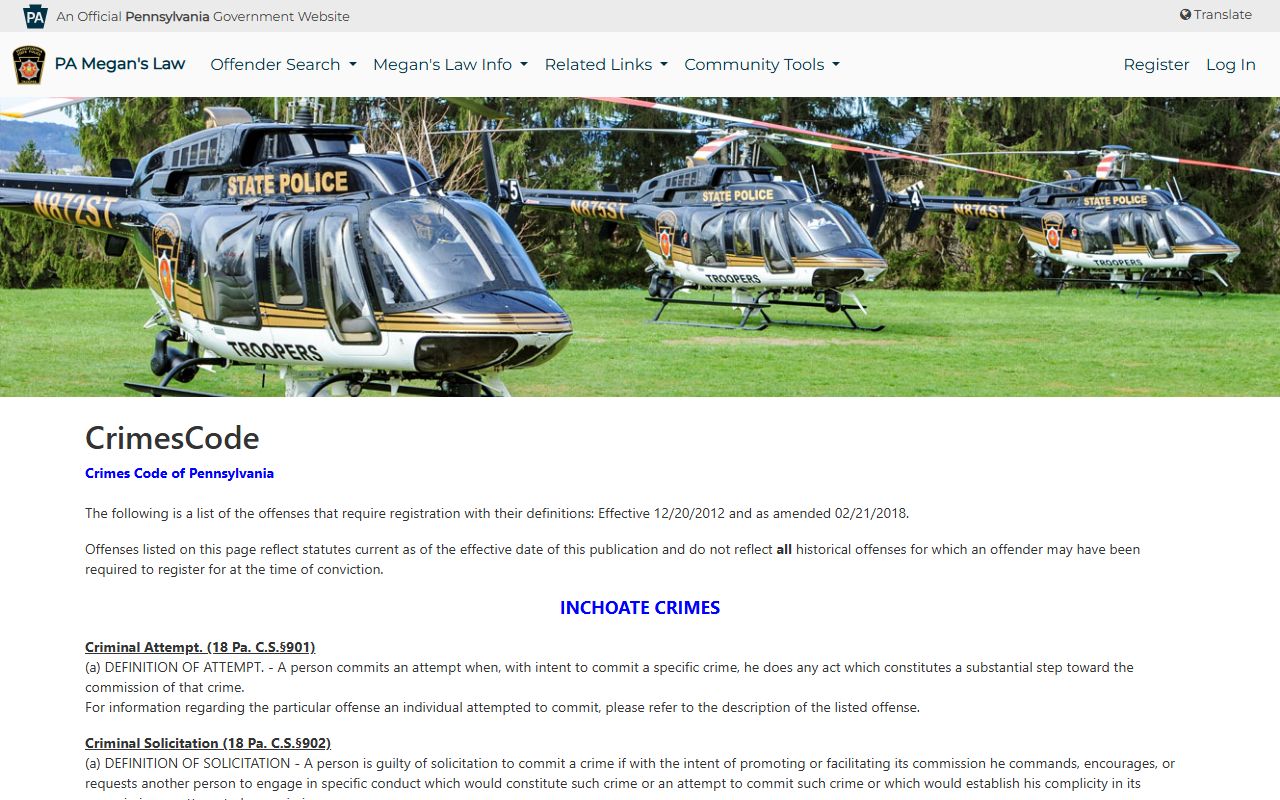 This resource is useful for understanding why a particular person appears on the registry and what type of offense led to their registration.
Note: A complete set of definitions and legal terms used in the Megan's Law statutes can be found at the Terms and Definitions page on the registry website.
Key Terms in the Pennsylvania Sex Offender Registry
The official registry website includes a glossary of terms to help the public understand the legal language used in offender profiles and registry notices. This screenshot shows the Terms and Definitions page for the Pennsylvania Megan's Law database.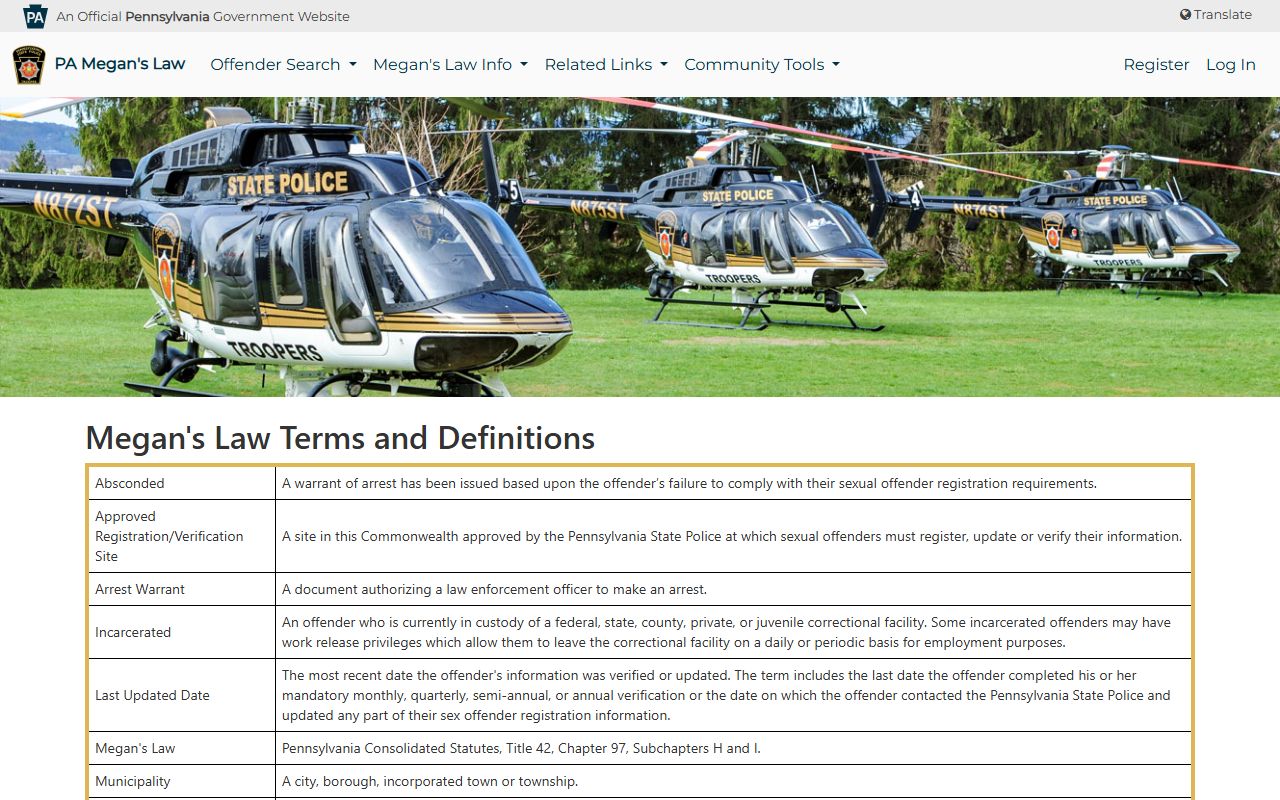 Understanding these terms is important for correctly interpreting what is displayed in a sex offender's registry profile.
Terms like "Sexually Violent Predator" and "Sexually Violent Delinquent Child" carry specific legal meanings under Pennsylvania law. A Sexually Violent Predator is an offender who has been assessed and found to have a mental abnormality or personality disorder that makes them likely to engage in predatory sexually violent offenses. This designation triggers additional community notification obligations beyond what standard tier registration requires. The SVP label is determined through a formal assessment process, not automatically assigned based on the offense alone.
The term "transient" refers to an offender who does not have a fixed residence. Transient offenders are still required to register and report monthly to law enforcement. They must provide information about where they sleep and spend time, even without a permanent address. This ensures that offenders without stable housing remain visible to authorities and the public.
The full set of code regulations governing Pennsylvania's Megan's Law appears in Title 37 of the Pennsylvania Code. The image below is from the Code Regulations for Megan's Law, Chapter 56.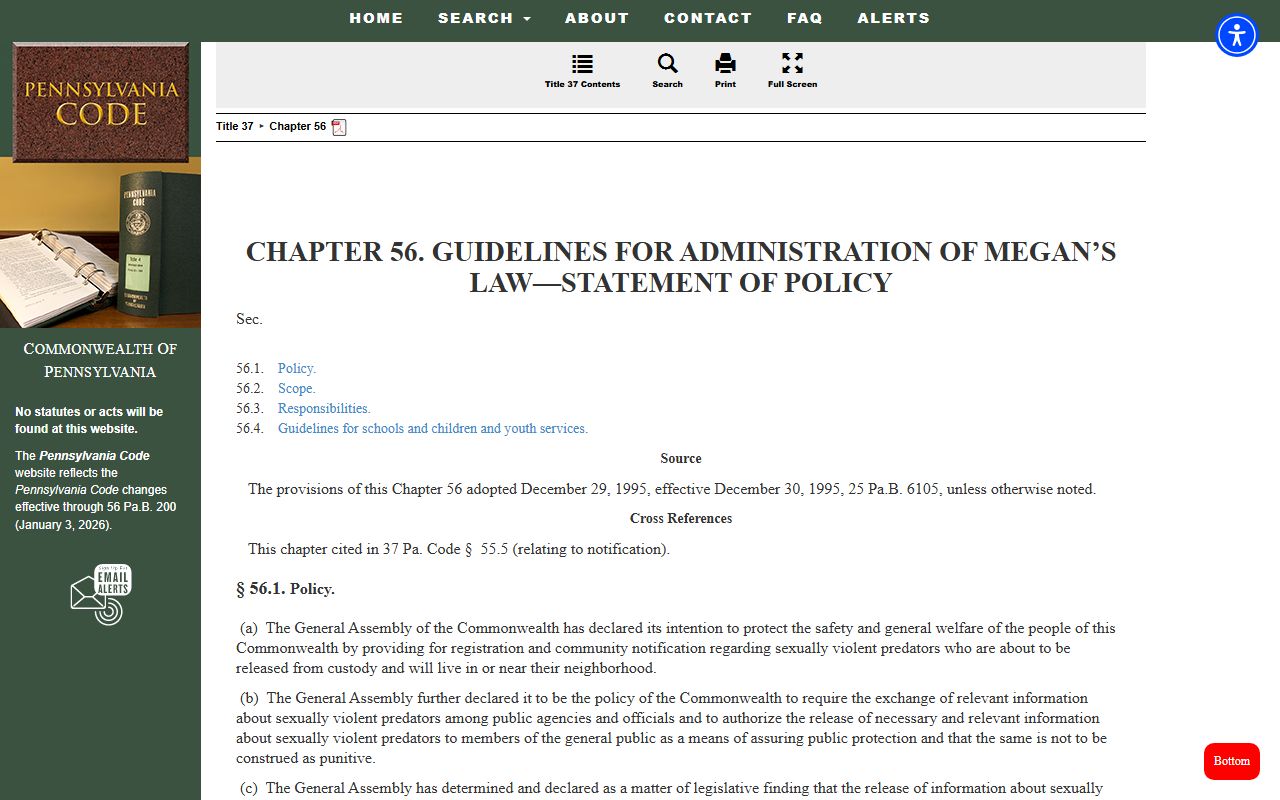 Chapter 56 of Title 37 provides the full administrative framework that governs how Pennsylvania carries out its sex offender registration and notification program.
Sexually Violent Predators in Pennsylvania
The Pennsylvania Sexual Offenders Assessment Board (SOAB) is responsible for assessing offenders to determine whether they qualify as Sexually Violent Predators. The SOAB operates under the Pennsylvania Department of Corrections and consists of 76 members drawn from fields including psychiatry, psychology, and criminal justice. After conviction, an eligible offender is referred to the SOAB for evaluation. The Board must complete its assessment within 90 days of the conviction.
The SOAB examines factors such as the nature of the offense, the offender's history, psychological profile, and any evidence of predatory behavior. If the Board determines that the offender has a mental abnormality or personality disorder making predatory behavior likely, a court hearing is held. At the hearing, the court reviews the SOAB's findings and decides whether to formally designate the offender as a Sexually Violent Predator. The full process is described at the SOAB Process Overview page.
More information about the Board's structure, mission, and membership can be found at the About SOAB page on the official Pennsylvania government site. The SOAB homepage also provides links to assessment forms, research, and relevant statutes governing the Board's work.
This screenshot shows the SOAB homepage on the official Pennsylvania government website. The SOAB plays a critical role in identifying the most dangerous sex offenders in Pennsylvania and ensuring they receive appropriate long-term supervision.
The SOAB Assessment Process
The SOAB Process Overview page walks through each step of the assessment from referral to court determination. This image shows the SOAB Process Overview page on the Pennsylvania government website.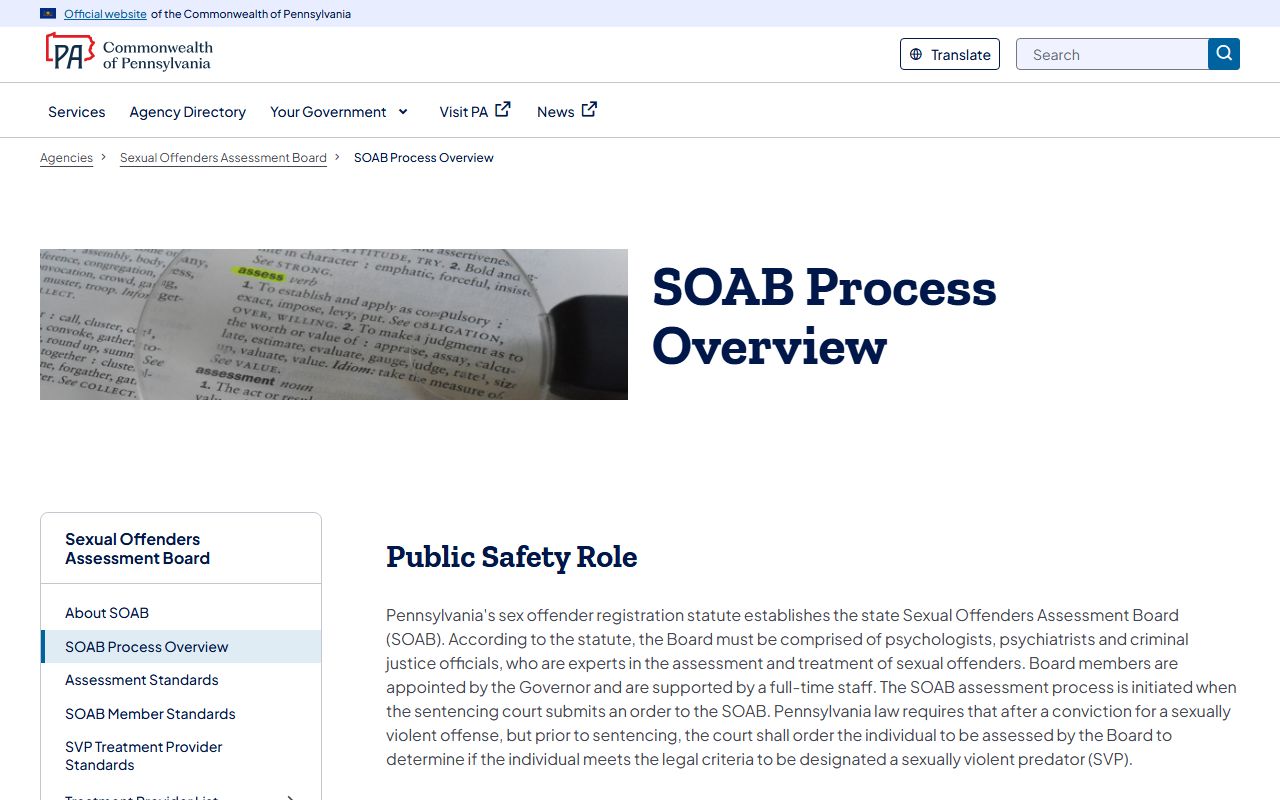 The process is designed to be thorough and evidence-based, ensuring that SVP designations are based on careful professional evaluation rather than solely on the offense of conviction.
When a court makes an SVP determination, the offender is notified of this designation and its consequences. SVP status means lifetime registration, quarterly reporting, and community notification requirements that go beyond what standard Tier III registration involves. SVP offenders must also attend sexual offender counseling programs as directed by the court. The About SOAB page provides background on the Board's history and the statutory basis for its work.
The About SOAB page also explains the qualifications required of Board members and how the assessment process aligns with Pennsylvania's legal standards for SVP designation. The Board's work directly affects the level of public notification that communities receive about specific offenders in their area.
This image is from the About SOAB page, which explains the Board's composition and statutory basis.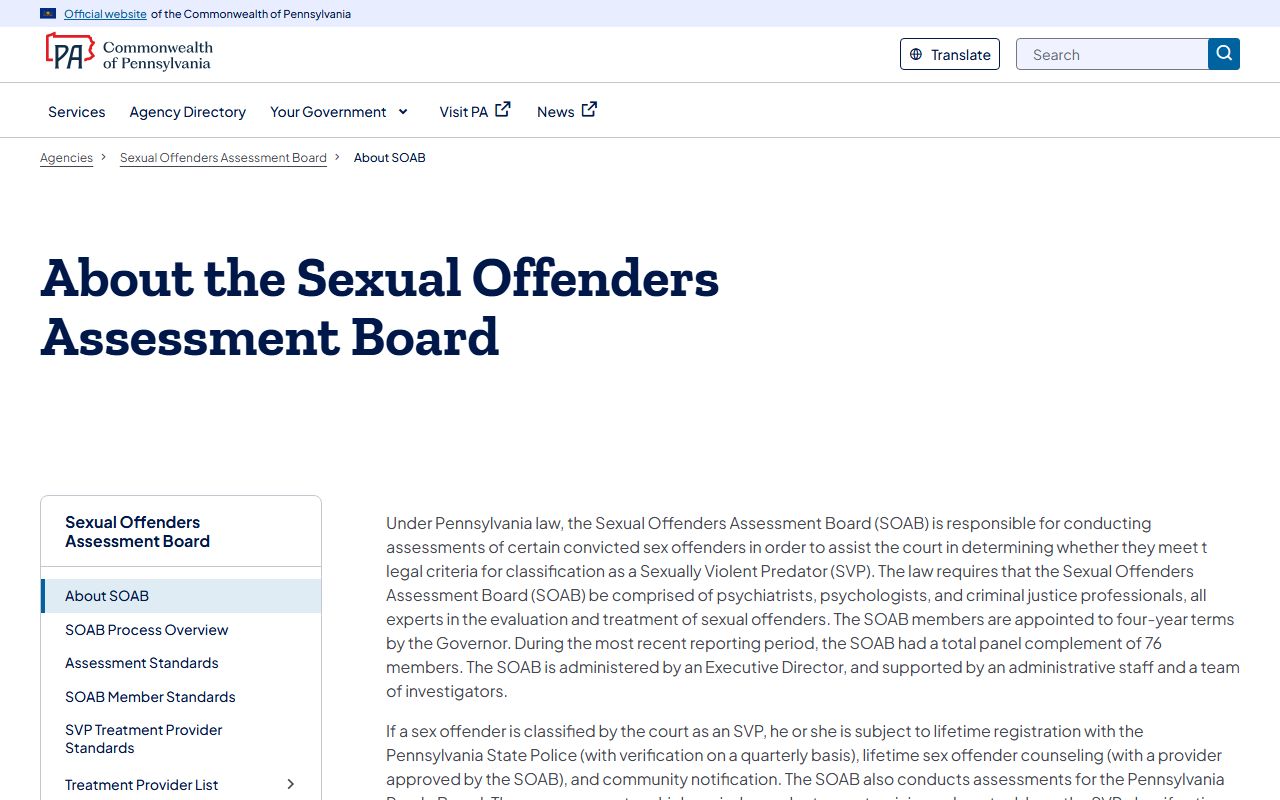 The SOAB's independence and professional standards are central to the integrity of the SVP designation process in Pennsylvania.
Community Notification in Pennsylvania
Community notification in Pennsylvania applies only to Sexually Violent Predators and Sexually Violent Delinquent Children. When an SVP or SVDC is released or moves to a new address, law enforcement conducts active notification of the surrounding community. This goes beyond simply updating the online registry. Law enforcement personally notifies neighbors within 250 feet of the offender's address or the 25 most immediate residences, whichever is greater. Schools within one mile also receive notification, as do daycare centers and colleges within 1,000 feet. The county children and youth services director is also notified.
Standard Tier I, II, and III offenders who are not designated as SVPs or SVDCs do not trigger this level of direct community notification. Their information is publicly accessible through the registry, but law enforcement does not proactively contact neighbors or local institutions when those offenders move. This distinction is significant. It means that residents must actively check the registry for information on most registered sex offenders rather than expecting to be notified automatically.
The Pennsylvania Commission on Crime and Delinquency (PCCD) supports community-based efforts to address the impact of sex offenses and assists with implementation of notification programs across the state. The PCCD provides funding and coordination resources that help local agencies carry out their obligations under Megan's Law.
The Pennsylvania Commission on Crime and Delinquency homepage offers information on the agency's role in supporting Megan's Law implementation and victim services. The screenshot below is from the PCCD homepage.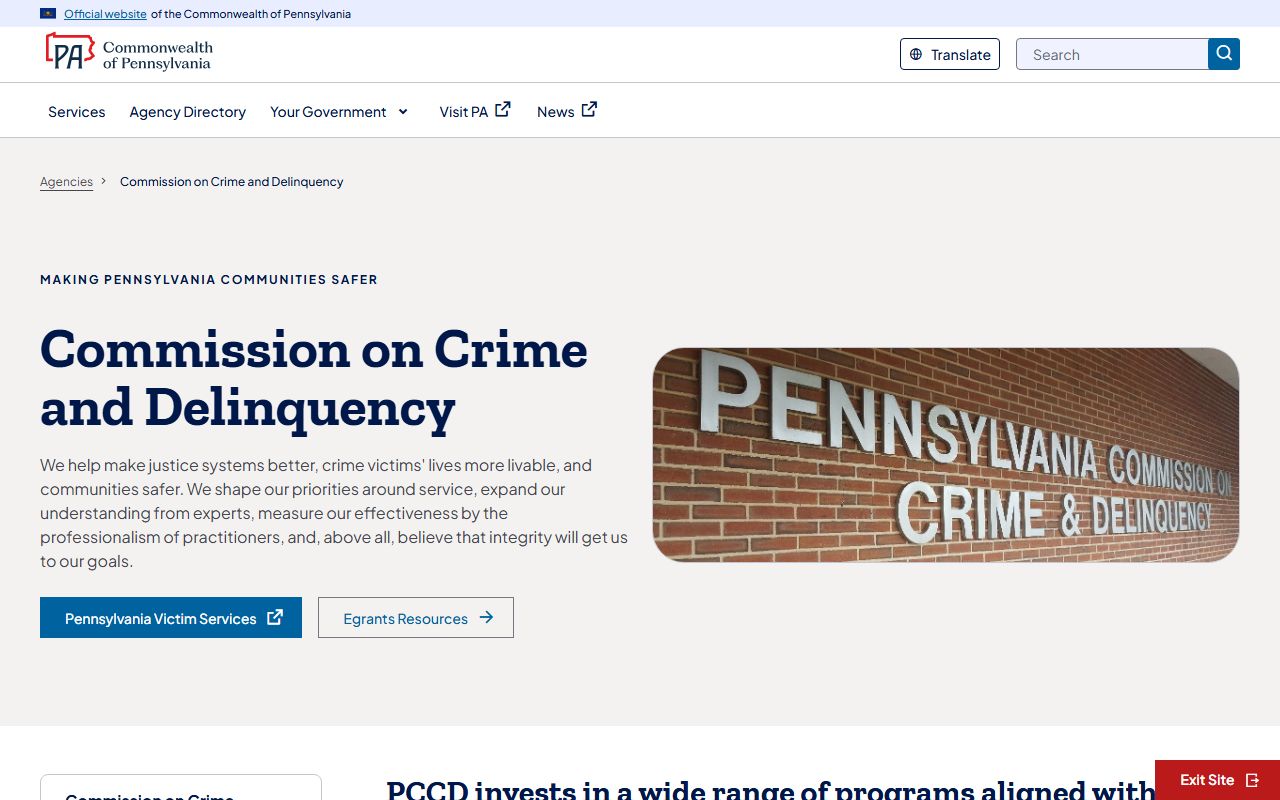 PCCD supports law enforcement, victims, and communities throughout Pennsylvania in responding to sexual offenses and managing offender populations.
Electronic Notification for Pennsylvania Residents
Pennsylvania offers a free electronic notification service through the Megan's Law website. Residents can register up to five addresses and receive email alerts whenever a registered sex offender moves into or out of a five-mile radius of any of those addresses. This service is voluntary and requires only an email address to sign up. It is available to anyone in Pennsylvania who wants to stay informed about offender movements in areas that matter to them.
The notification service is one of the most practical tools available to Pennsylvania residents who want ongoing awareness without needing to manually check the registry. Parents, school administrators, and community organizations frequently use this service to monitor offender activity near schools, daycare centers, parks, and neighborhoods. Signing up takes only a few minutes on the Pennsylvania Megan's Law website.
Note: Electronic notifications cover the five-mile radius around designated addresses and do not replace direct community notification for SVP-level offenders in Pennsylvania.
Pennsylvania State Police and the Registry
The Pennsylvania State Police is the agency that maintains and enforces the sex offender registry across all 67 counties. The screenshot below shows the Pennsylvania State Police agency page on the official Pennsylvania government website.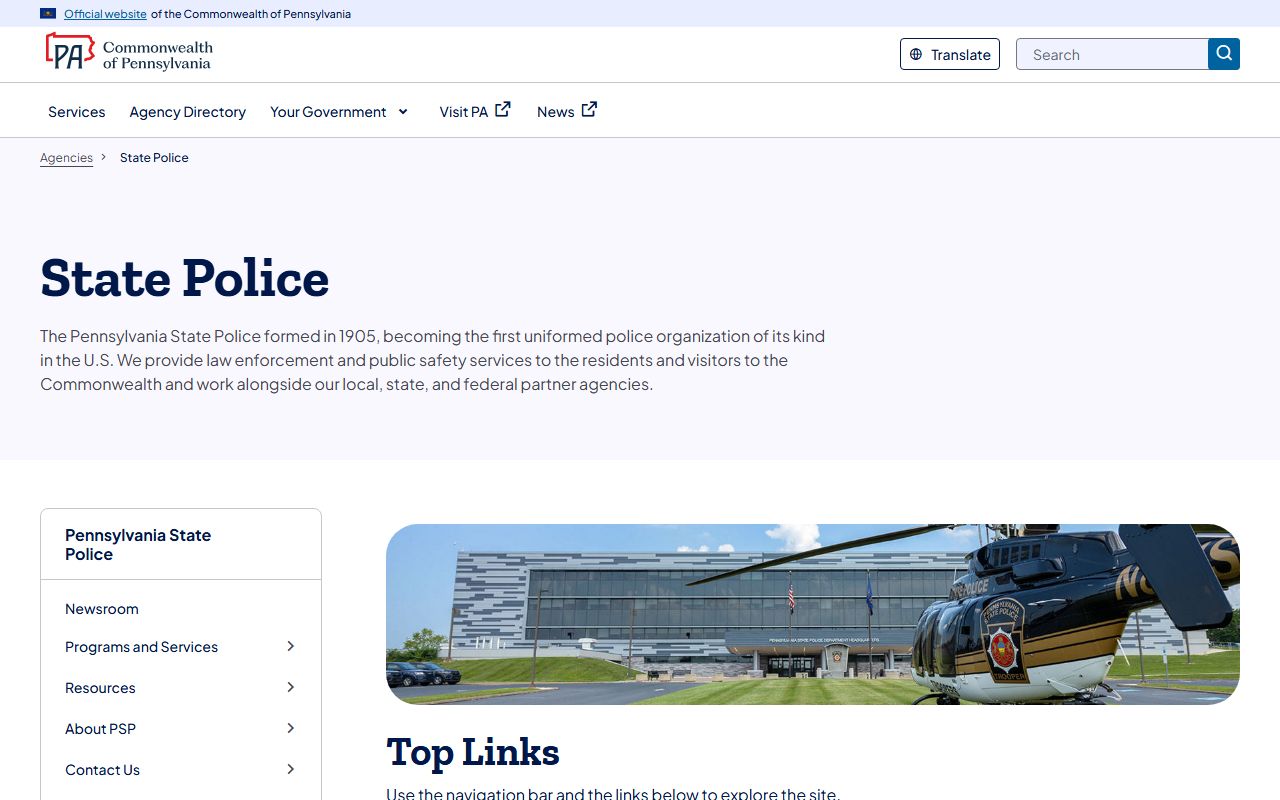 The State Police coordinate with county and municipal law enforcement to verify offender information, conduct compliance checks, and investigate registration violations.
The State Police's responsibilities under Megan's Law are spelled out in 42 Pa.C.S. § 9799.32. This section requires the State Police to establish and maintain the statewide database, make registry information available to the public, and assist local agencies with compliance enforcement. The State Police also handle international travel notifications and coordinate with federal agencies when offenders cross state lines.
The PA Consolidated Statutes Title 42, Chapter 97 provides the full legal framework for all of these obligations. Residents who want to understand the law in detail can review the statutes through Justia's hosted version of Title 42, Chapter 97, which covers the complete body of Pennsylvania's sex offender registration and notification law.
The Pennsylvania Consolidated Statutes contain the full legal text of Pennsylvania's sex offender registration and notification laws. This image shows PA Consolidated Statutes Title 42, Chapter 97 as hosted on Justia.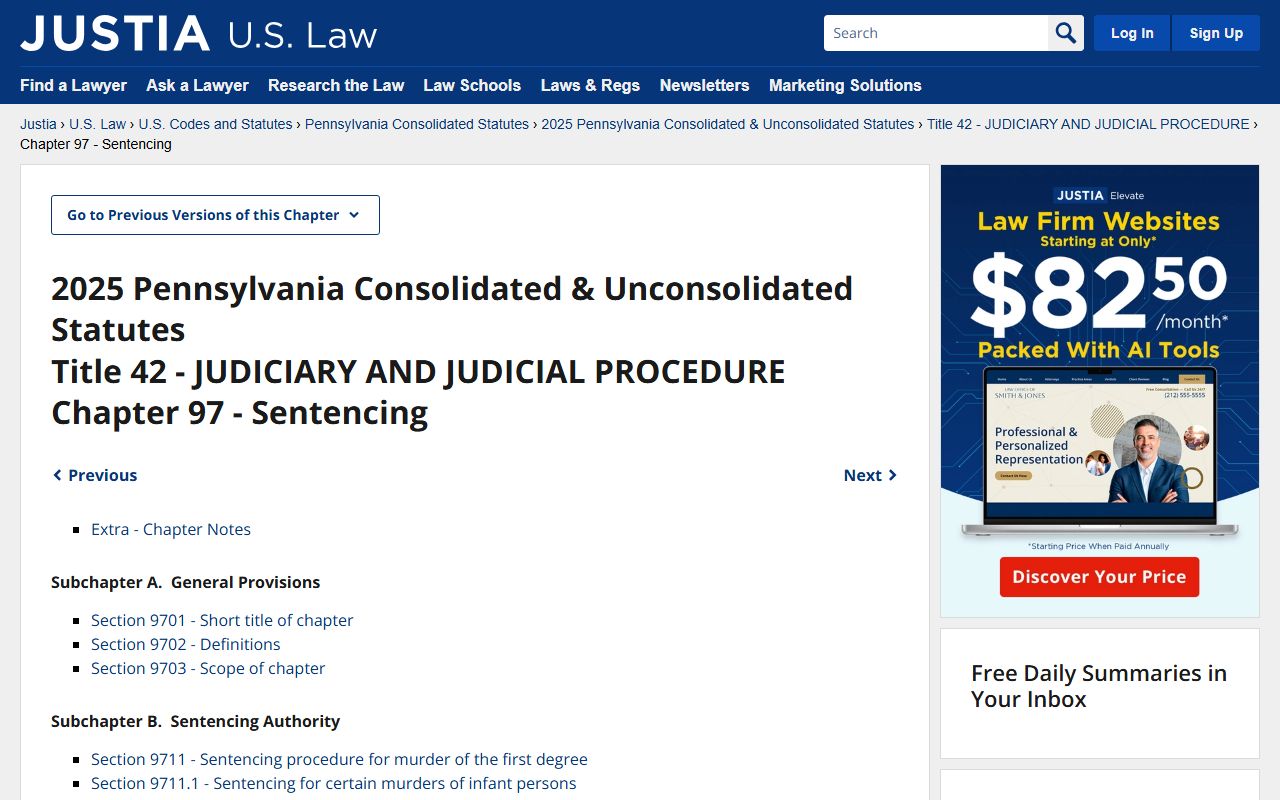 Chapter 97 of Title 42 is the primary statutory authority for every aspect of Pennsylvania's Megan's Law program.
Victim Rights and Support in Pennsylvania
Pennsylvania provides specific protections and notification services for victims of sex offenders designated as Sexually Violent Predators or Sexually Violent Delinquent Children. When an SVP or SVDC changes their address, the Pennsylvania Office of Victim Advocate (OVA) sends written notice to the victim of record. This allows victims to be informed whenever a particularly dangerous offender moves, without having to monitor the registry themselves. Victims of standard-tier registered offenders do not receive this automatic notification under current law.
Victims who qualify for OVA notification services can contact the Office of Victim Advocate at 1-800-563-6399. Additional information and resources are available at the OVA website. The OVA provides advocacy, support, and case monitoring services to crime victims throughout Pennsylvania, with a particular focus on victims of serious violent crimes including sexual offenses.
The Child Abuse Hotline operated by the Pennsylvania Department of Human Services is available at 1-800-932-0313 for reporting suspected child abuse anywhere in the state. This line operates around the clock and connects callers to the appropriate child protective services agency for their county.
The Office of Victim Advocate plays a central role in ensuring that sex offense victims stay informed about offender movements. The screenshot below is from the Office of Victim Advocate website.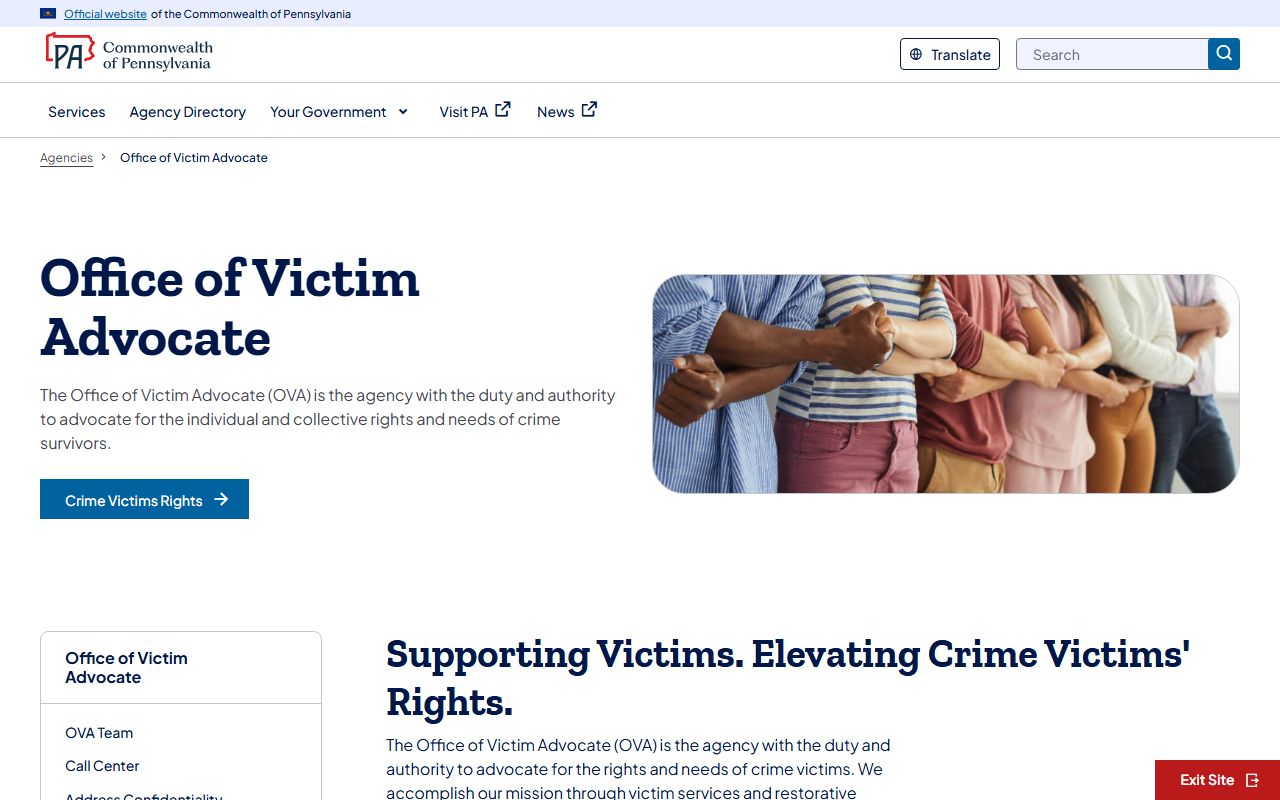 The OVA works alongside law enforcement and the courts to make sure that victims of sexual violence have access to the information and support they need throughout the criminal justice process.
Juvenile Offenders and Pennsylvania's Registry
Pennsylvania's treatment of juvenile offenders under Megan's Law changed significantly after 2014. The Pennsylvania Supreme Court struck down the juvenile registration requirements of SORNA in the case In re: J.B. (2014). As a result of that ruling, juveniles are no longer required to register under Megan's Law in Pennsylvania unless they are classified as a Sexually Violent Delinquent Child (SVDC). The SVDC classification requires a separate court determination following a formal assessment process similar to the SVP process for adult offenders.
The elimination of broad juvenile registration requirements reflects a recognition that treating juvenile offenders identically to adult offenders raises constitutional concerns and may not serve the goals of either public safety or rehabilitation. Pennsylvania courts continue to require SVDC registration for juveniles who are assessed to pose a serious long-term risk, while sparing other juvenile offenders from the lifetime consequences of public registry listing.
Note: Juveniles adjudicated as Sexually Violent Delinquent Children face the same lifetime registration and quarterly reporting requirements as adult SVPs in Pennsylvania.
Reporting Non-Compliance in Pennsylvania
Failure to register or comply with reporting requirements is a serious criminal offense in Pennsylvania. Depending on the tier of the offender and the nature of the violation, non-compliance can be charged as a felony of the first, second, or third degree. Pennsylvania also makes it a felony of the third degree to help a registered offender evade law enforcement. This provision extends legal liability to family members, friends, or associates who assist an offender in avoiding registration obligations.
If you believe a registered sex offender has failed to report a change of address or otherwise violated their registration requirements, you can report it by calling 1-866-771-3170. This is the non-compliance reporting line maintained by the Pennsylvania State Police. Reports can be made anonymously. Law enforcement will investigate and take appropriate action based on the information received.
Non-compliance with Pennsylvania's Megan's Law is prosecuted aggressively. Courts have upheld substantial prison sentences for offenders who fail to register or who provide false information to avoid detection. The strict enforcement posture reflects the legislature's intent to make registration a meaningful public safety mechanism, not merely a paperwork requirement.
Additional information about compliance obligations, reporting schedules, and penalties for violations is available through the registration information page on the Megan's Law website and through the full text of the Code Regulations for Megan's Law in Title 37 of the Pennsylvania Code.
Browse Pennsylvania Sex Offenders by County
The Megan's Law registry covers all 67 Pennsylvania counties. Select a county below to find registered sex offenders in that area.
Major Pennsylvania Cities - Sex Offender Search
Search for registered sex offenders in major Pennsylvania cities using the links below. Each city page provides local registry information and search tools.